
|
|
||||||||||||||||||


| New revised electoral calendar (Oct. 28, 2026) |

|
 |
|
|
|
|
|
|
|||||
|
|
Haiti - Security : Report on Maritime and Port Security in Haiti (2026 report) 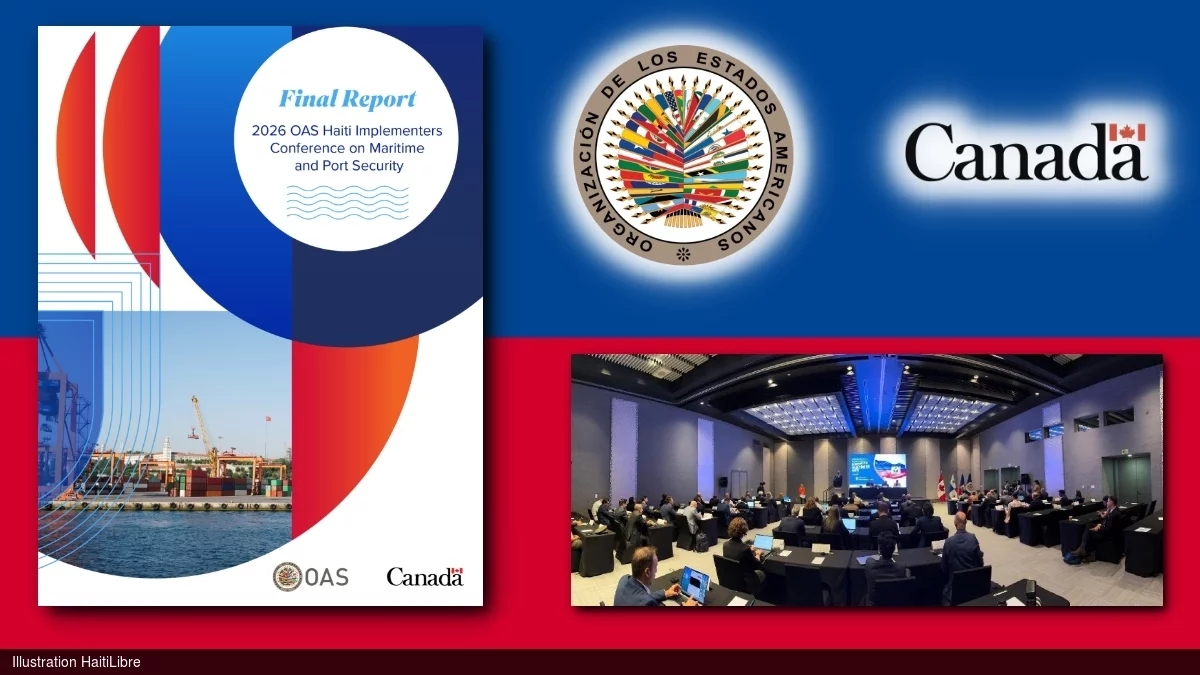
To promote a more unified approach and a better understanding of the current maritime and port security landscape in Haiti, the Secretariat of the Inter-American Committee against Terrorism (CICTE), with funding from the Government of Canada’s Anti-Crime Capacity Building Program (ACCBP), convened the OAS Conference on Maritime and Port Security Stakeholders in Haiti. The conference brought together representatives from 11 OAS member states, one OAS observer state, 12 international and/or multilateral organizations, several OAS departments, and subject-matter experts from the private sector, regional agencies, and academia. As part of a pre-conference survey, participating implementing organizations were asked to provide information on their ongoing and planned initiatives, areas of intervention, and partnership priorities. The information gathered beforehand proved instrumental in shaping the structure and content of the conference discussions. The study focused on the Port-au-Prince port complex (the APN terminal, Port Lafito, and the Varreux terminal), with the goal of transforming these areas from high-risk zones into stable hubs that comply with the International Ship and Port Facility Security (ISPS) Code. Four pillars in urgent need of modernization : Physical and perimeter security : Fencing and access controls are inadequate, given the presence of gangs right at the port gates. Technological infrastructure : Lighting and video surveillance systems are failing to provide 24/7 monitoring. Human oversight : Security personnel lack standardized training and unified command. Operational risk : Areas controlled by gangs necessitate a shift from passive to active protection for vessels. Summary of the situation on the ground : National Port Authority (APN) : Manages infrastructure and ISPS (International Ship and Port Facility Security) compliance. It faces challenges including the presence of gangs just outside its gates, internal corruption, and a lack of sustainable funding. Armed Forces of Haiti (FAdH) : Responsible for protecting strategic infrastructure. The institution is currently being rebuilt while facing significant budgetary and logistical constraints—including a shortage of patrol vessels, drones, and secure radios—as well as personnel limitations. Haitian Coast Guard (PNH) : Tasked with monitoring 1,700 km of coastline and combating trafficking. They contend with an aging and inadequate fleet and lack a dedicated budget line within the National Police, which limits their operations to a reactive role. General Administration of Customs (AGD) : Processes over 180,000 containers annually. It lacks modern scanning equipment and must shift its focus—historically centered on tax collection—toward the detection of concealed weapons and narcotics. Anti-Narcotics Trafficking Brigade (BLTS) : Has successfully carried out major seizures of weapons and drugs at ports, despite having very limited resources (notably the absence of an integrated surveillance center and high-speed patrol boats). Haitian National Police (PNH) : Secures strategic entry points and the corridors connecting ports to urban centers, while also having to manage the porous 92 km land border with the Dominican Republic. Haitian Maritime and Navigation Service (SEMANAH) : Regulates maritime traffic and environmental protection. Haiti’s accession to the IMSO in November 2025 paves the way for the establishment of a Maritime Surveillance, Search and Rescue Coordination Center (CROSS), although the agency currently lacks modern equipment and technical personnel. It also monitors inland waters, notably Lake Azuéi. Proposed Solutions and Roadmap : The report advocates for a two-staged approach to move away from a reactive and fragmented posture : Phase 1 : Immediate "Quick Wins" Joint Task Force : Activate a task force comprising the PNH, GSF and Customs authorities to secure the immediate perimeter of the Port-au-Prince terminals. Securing logistics corridors : Deploy a joint PNH-GSF protocol to neutralize gang-run toll and extortion checkpoints along road arteries leading from the ports, and to provide escorts for commercial and humanitarian cargo. Monitoring informal landing sites : Collaborate with local communities to identify clandestine landing points used for arms smuggling. Initial legal modernization : Draft regulations requiring Advance Notice of Arrival (ANOA) for vessels and launch a digital single window for inter-agency data sharing. Phase 2 : Long-term institutional reforms : Maritime code and translation: Align the Haitian maritime code with IMO standards and translate all ISPS (International Ship and Port Facility Security) manuals and training materials into French and Haitian Creole. National Maritime Training Academy: Institutionalize skills development through "train-the-trainer" programs. Sustainable port security fund: Establish a dedicated fund, financed by specific port fees, to cover the maintenance of equipment, patrol vessels, and infrastructure, reducing reliance solely on international donations. Final Strategic Recommendations : The report concludes that security on land and the delivery of humanitarian aid (intended for 1.5 million displaced persons) are directly dependent on maritime control: Unified Haitian Leadership : Place all initiatives under a National Maritime Security Strategy led by Haitian authorities to avoid the duplication of international efforts. Inter-institutional Port Control Center : Establish a unified command center to oversee port facilities and their maritime approaches (initially launched in cooperation with the FRG, with a full transition to Haitian authorities to follow). Intelligence and Surveillanc e: Shift from fragmented, paper-based records to a structured intelligence cycle (utilizing radar, satellites, and AIS systems) to target vessels of interest. Integrity and Anti-Corruption Measures : Implement rigorous vetting processes, mandatory ethics training, and competitive salary scales to reduce the vulnerability of personnel to corruption. Download the full 51-page final conference report (PDF, in English ): haitilibre.com/docs/2026-OAS-HAITI-IMPLEMENTERS-CONFERENCE---Final-Report.pdf SL/ HaitiLibre
|
|









|
|
Why HaitiLibre ? |
Contact us |
Français
Copyright © 2010 - 2026 Haitilibre.com |